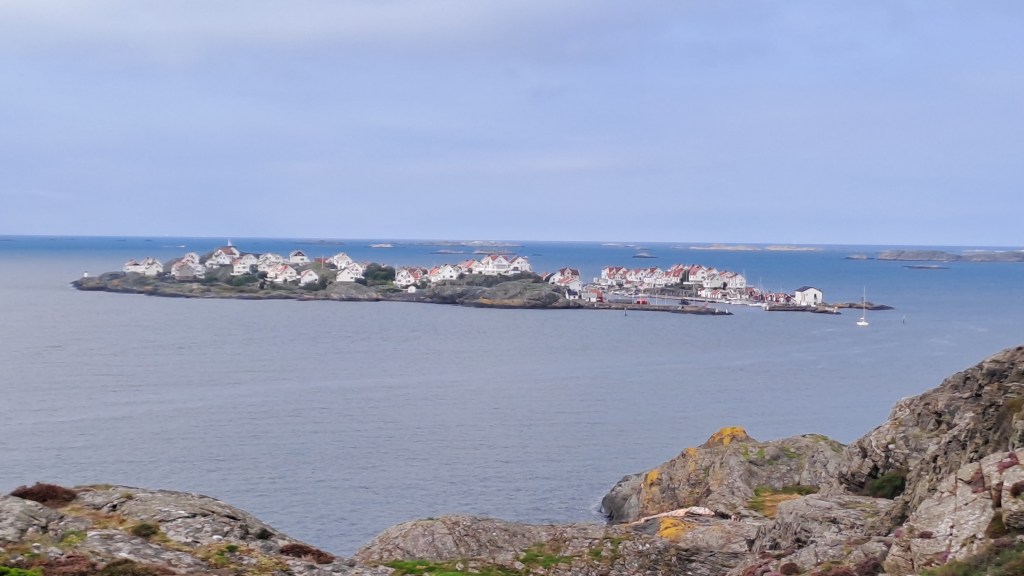
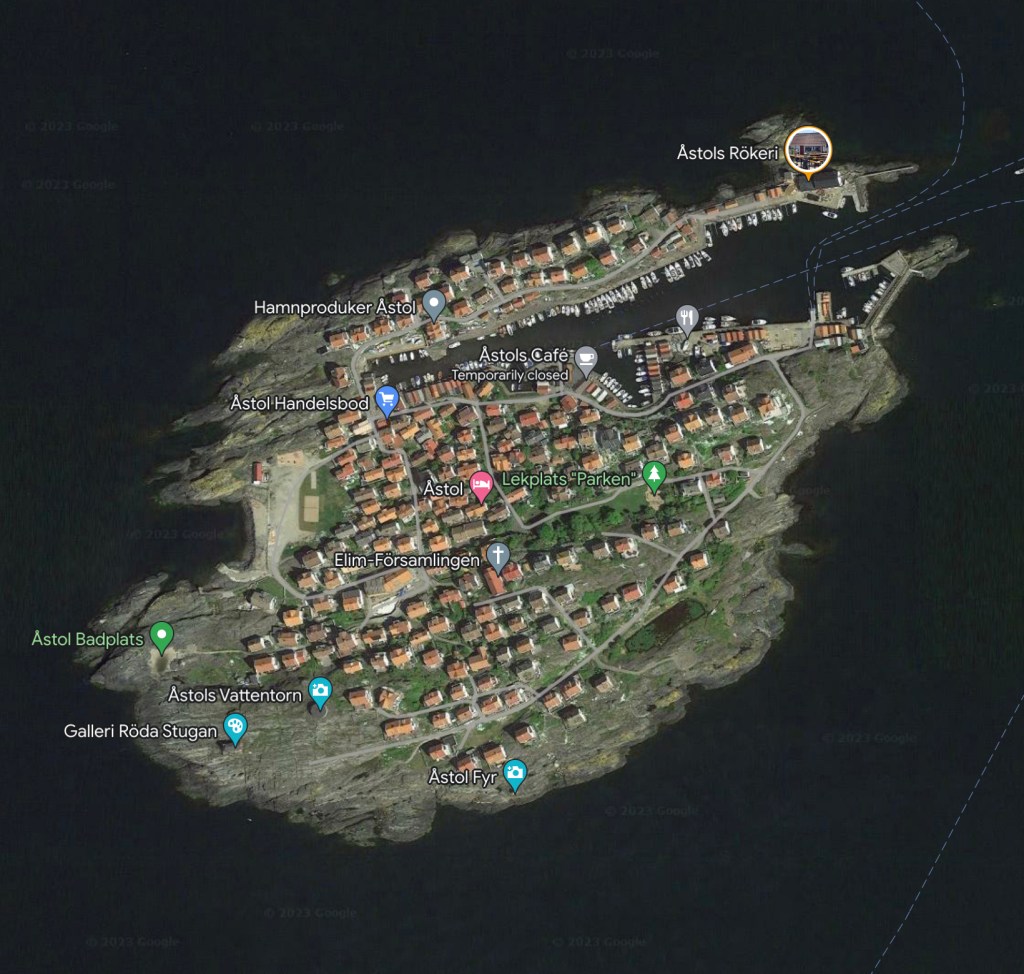
Recently I visited a friend Robert at his home in Sweden. We have known each other since our time together on the MV Logos way back in the late 1970s. Keeping up this maritime background he and his wife Maria have now lived about 35 years on the small island of Åstol. The Å in Åstol sounds quite like the English ‘O’, as in oats. It is situated about 60km north west of Gothenburg. The history and culture of the island is interesting. This is so even with the many impressive islands that Sweden boasts of. I wrote a bit about Swedish islands in ‘East or West?’
During this recent stay I was taken by my hosts to an interesting lecture by Per-Aste Persson on the history of the island. Most attending had roots in Åstol. Packed like sardines in a church hall those I met were either permanent residents, had relatives on the island or had memories of growing up there. The talk challenged my Swedish – quite a lot of reference to archaic parish church records. Also lots of technical fishing terms. However it was very interesting. There was also an air of realism to it as many in the audience no doubt felt part of the history.
Inhabited for about 250 years the island’s story is rooted in fishing. Particularly the herring industry. The long east facing and relatively deep harbour meant it was an excellent shelter from prevailing west and south west winds.
When the herring were abundant everyone prospered. There was no grazing land so no animals. No crops could be grown on the rocks either. However fish caught could be bartered for potatoes and vegetables on the large island of Tjörn. When the herring moved elsewhere or otherwise disappeared it was poverty, hardship and drunkenness that prevailed. At such times the only thing that prospered was the public house. Some pub landlords were particularly cruel. One in particular was feared. He would willingly let drinkers drink on credit. If there was no fish there was no money. He would then go round the houses demanding their jewellery and valuables for payment.
Åstol has always had close links with other coastal communities in Norway and Denmark. Though Åstol has no trees there was trade in timber as well as smuggling activities.
As well as the fluctuations in fishing fortunes there was also an ebb and flow in the spiritual life of the community. Interestingly, one historian seems to think this was in tandem with better fortunes in the herring fishing. A number of the island’s older inhabitants today were affected by the Christian revivals that swept the island on more than one occasion. The biggest seemed to be in 1923 influenced by ports in England. This affected the whole island. Church members grew to 153. It’s a bit of an aside but this number sounds quite intriguing coming from a fishing community. In John 21 vs 11 the disciples brought fish ashore to have breakfast with Jesus. The number of fish was 153! Along with growth in the church there was renewed investment in boats.
Over the years, as with any community dependent on the sea, Åstol has had its share of tragedies. There is a memorial for those who perished at sea with no trace.
As mentioned in the 1920s there were also links with the fishing communities of England. This included Hull. Vessels from Åstol sheltered in coastal fishing ports in England and Scotland when strong easterly winds pushed them there.
A major innovation was when boats became motorised. This gave greater range and scope for different types of fishing. The first engine powered boat arrived in 1905 and was greeted with great fanfare. It was the lecturer Per-Aste Persson’s paternal great grandfather that brought this first motorised vessel to the island. Initially these engine powered vessels towed several sailing boats out to fishing waters.
Another period of spiritual awakening is recorded in 1948 when 126 were baptised. In 1967 one of the 2 churches had 266 members. At the same time in the 60s there was an enormous growth in fishing. As at the end of the 1920s many skippers, led by their faith, invested in ever bigger and more modern vessels. At its peak 25 trawlers operated from this little harbour. Then it had the country’s most modern fleet.
That all changed in the 1970s. when many chose different employment. Commuting to work in such places as the petrochemical industry on the mainland port city of Stenungsund. This move away from the variable fortunes of fishing was over 50 years ago. Yet even today the nicknames of indigenous families are the names of the trawlers their forefathers had.
What about Åstol today? Fishing-wise there is only one fisherman doing it for a living. I met him with my friend. It seemed a somewhat lonely occupation on the island today. He in the harbour surrounded by tourist boats, yachts and islanders run abouts. All the locals are hobby fisherman. Many were getting ready to fish the lobster season with the permitted 6 pots allowed for an amateur.
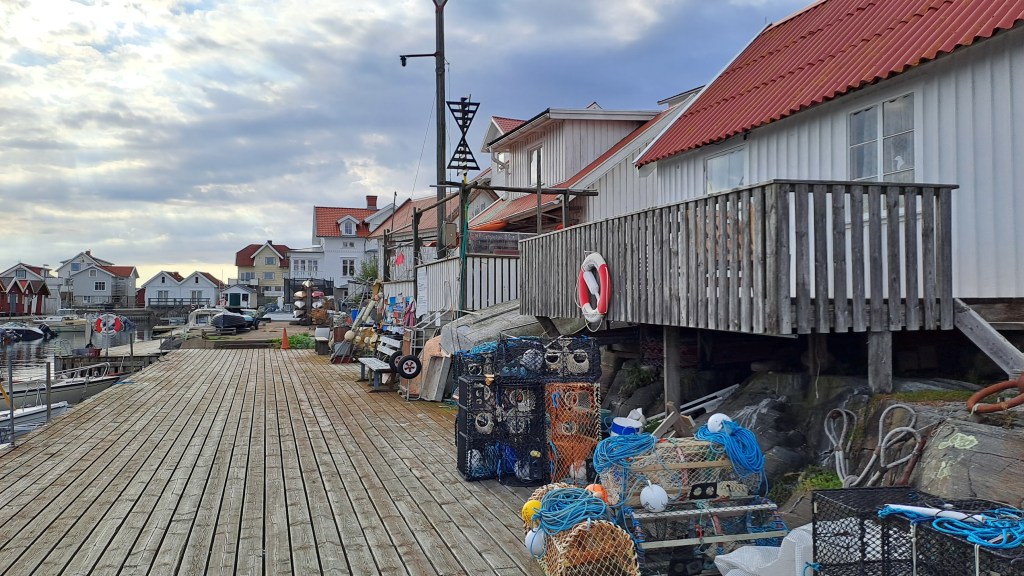
It is said the fishing families of Åstol’s past had 3 main possessions. Their house, their boat and the boathouse. When storms came the priority was to rush to the harbour to check the boat and its moorings. Then look at the state of the boathouse. If they were OK then check on the house!
Nowadays the island community consists of two main groups. Those who live permanently on the island are about 50 households, including my friend. A second grouping consists of over a hundred other houses occupied by those for whom Åstol is a second home. They come mostly on weekends. Everyone has to get along as houses are incredibly close to each other. Trying to be a good neighbour without being on top of one another. Always greet people, even if there are tensions. There are community responsibilities. Each takes their turn to help keep the harbour tidy. The life of the community is no longer sustained by a total dependence on fish. However today it still demands cooperation and getting along with your neighbour.
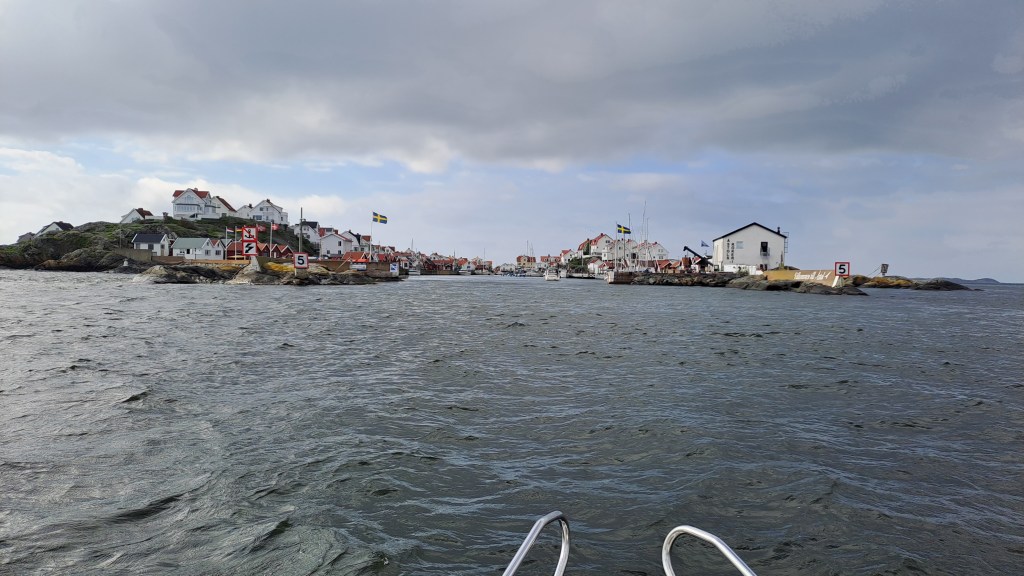
Most have their own boat in the harbour, used for visiting neighbouring islands or for hobby fishing. The ferry operates frequently and carries everything to sustain life on the island. Anything from building materials to food. Being onboard the ferry also affords an opportunity to get local news from your neighbours. Supplies are taken home in hand pulled carts that lie at the ferry terminal.
There is in fact a third category of people. Tourists, day visitors and those arriving on yachts from elsewhere. The picturesque harbour, lighthouse, cafe, the gallery and smokehouse restaurant is very attractive in the warmer months. Community events such as the annual swim around the island attract people from afar.

With no roads the absence of cars makes for a lovely, peaceful place. This is so despite the fact that everyone lives near each other. The harbour is more than just a shelter for boats but also a soothing balm for frazzled mainland dwellers. Apart from the occasional purring of outboard motors when near the harbour the main sounds heard are mostly human. At night the murmur of neighbours chatting would occasionally drift in. Most households have their own boat moored in the harbour. Trips to and from the mainland by the ferry. Then use your own boat whilst on the island.
Well these are a few thoughts from a city dweller on what outwardly appears to be just a tiny, barren and rocky island. Bounded by the ever present vagaries of sea, wind, rain and a shifting economy. Yet blessed by its spiritual history and the seafaring traditions of the past. What will the future hold?
Writing this blog I am grateful for the aforesaid lecture by Per-Aste Persson as well as the mine of information on the island that Robert and Maria are. For those who wish to read more there is an interesting English work ‘Åstol – 250 Years and Beyond’ by Tess Ekman & John Hermansson.
 Allan Grant
Fascinating Allan … very descriptive and a very interesting post. Thanks
LikeLike
Thanks Paul.
LikeLike
Very interesting. From there appearance the lobster pots look very similar to the home made ones that were used by the crofter/fishermen of Scotland in the olden days. No room to run a marathon there.
LikeLike
Yes thought you might have something to say about the pots! 😀
LikeLike
That’s a lovely insight into the life of a small community. Thanks, Allan.
LikeLike
Thanks Adrian.
LikeLike
This provides a fascinating insight to a place and community I had not even heard of, Alan. So many small communities just on the edge of survival…..
LikeLiked by 1 person
Indeed, so many communities with a life of its own.
LikeLike
That was so interesting-thanks
LikeLiked by 1 person