
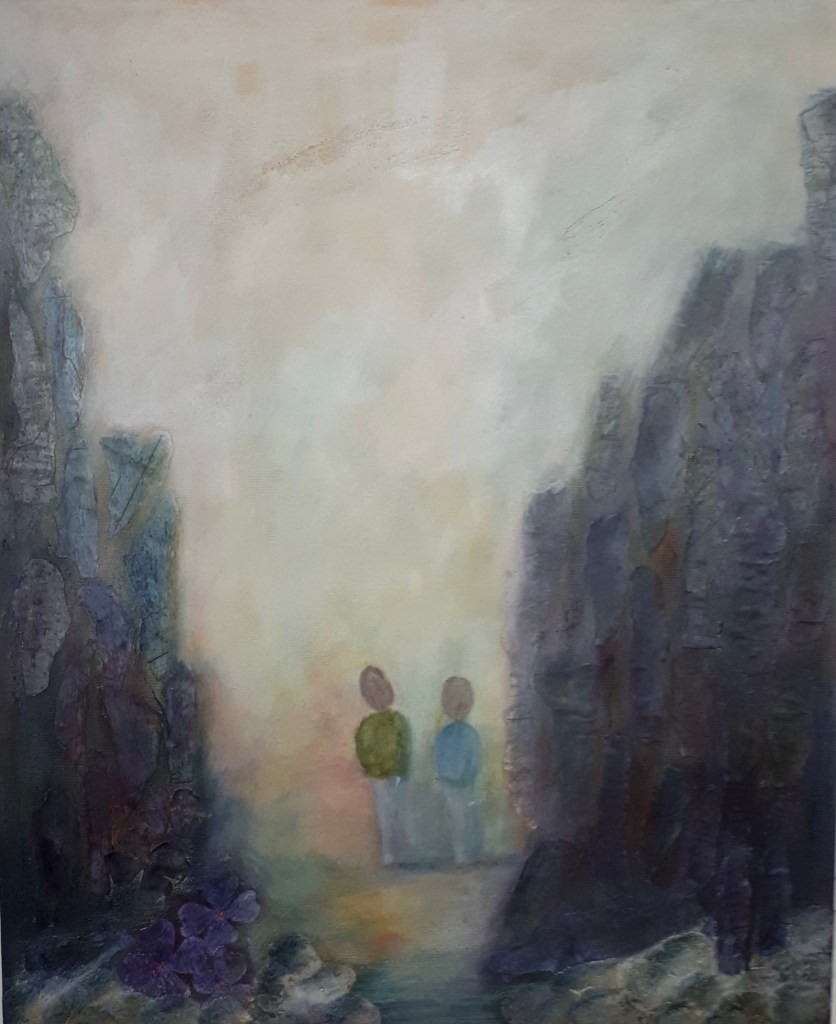
Shortly into the new millennium I moved on from working with Prison Fellowship Scotland (‘A Bruised Reed He Will Not Break’). A new chapter in the tapestry of life would open for me.
Emmaus communities are part of a worldwide network of organisations working with the homeless. The story begins in the Paris of 1949 in the aftermath of the 2nd World War. The first Emmaus community started when a French priest met a homeless man who had tried to commit suicide. The priest challenged him to live and work together with him and help those less fortunate.
The Emmaus ethos had a wholistic approach to meeting the needs of those who had no home. Emmaus was not just about giving people a bed, but also a reason to get out of it. Providing a home, a community and giving the dignity of work. Those living in an Emmaus community are known as ‘companions’. The word comes from the French for ‘those who share bread together’. The community name comes from the vivid post resurrection story of Jesus. Two of his disciples were walking on the road to Emmaus. They were downcast and sad over Jesus’ cruel death when a stranger came alongside them. This stranger accepted their invitation to hospitality. As their guest gave thanks for the meal the companions’ eyes were opened to who the stranger was. Jesus, now risen and in their midst. Hope and a new purpose was born in their hearts***.
Although having Christian origins Emmaus does not require any Christian commitment to become a companion or be a volunteer.
Though Emmaus grew over the subsequent decades into scores of communities around the world there was none in Scotland. Around the year 2000 a committee had been formed in Glasgow with the aim of creating Scotland’s first community. After a while they felt the need to engage someone full-time to help with turning the idea into a reality. I was encouraged by a friend to apply and in Sept 2000 started as Emmaus Glasgow’s development officer/ project manager. As a young Christian in my teens I recall praying for the homeless in Glasgow. In a strange way almost 25 years later I was back in Glasgow involved in a project seeking to help the homeless . Sometimes we can be the answer to our own prayers.
To start with there were few resources but a large vision. For several weeks I began this role working from our spare bedroom. The aim was to provide a home, work and family for around 24 companions. We had no building or facility. One of my tasks was hunting for a suitable property or land to develop despite Emmaus Glasgow having no money at that point. There followed many months of fruitless searches. Having no money to put on the table meant property developers would always win. We needed a sympathetic seller. A friend Robin was a trustee of a semi vacant church building in North Glasgow. Aware of our need he and his fellow trustees were prepared to sell the building and adjacent land to Emmaus. They would sell to Emmaus for a reasonable price. We could take the time required to fund raise the amount needed. It turned out this same building was where my office was when working previously for Prison Fellowship!
The building was substantial but would need a large amount of refurbishment, demolition and new build to make it fit for purpose. 24 high quality ensuite rooms for companions, a community kitchen and common areas. As well as this workshops, offices and a second hand store. The latter was to sell what companions had collected. This consisted mainly of used furniture and bric a brac. One of the ingenious simplicities of the Emmaus model was this kind of work. Someone who has been homeless, maybe for years, can join a community, and then engage in work the following day. Collecting, sorting or carrying things most people can do with little training. The world has woken up to the need to conserve the planet’s resources. Emmaus’ core business of recycling for over 70 years has become all the more relevant. Many communities also have a dog or community pet. Some who have lived isolated lives as homeless, find it difficult to talk or socialise when entering a community. A dog or pet can help those hurting or traumatised.
Back to the task at hand. We now had a building but now began a new phase. That of fund-raising, designing and building this purpose built facility. It sounds easy but that part of the development took the best part of 5 years and £3 million. Time and again we had virtually no money left in the kitty for the next stage. Catering to the diverse demands of the big funders was taxing.
Aside from the constant need for resources was another kind of challenge. Winning the hearts and minds of those who would live near the community. Most people would applaud the idea of housing the homeless. However not many neighbourhoods welcome such initiatives in their area. In the UK this is known as NIMBYism (Not In My Back Yard). To try and address concerns we arranged a consultation meeting with local people. We thought it made for good public relations. In hindsight I am not so sure. The meeting was one of the most dramatic I have experienced. Opposition was vocal and very loud. So much so that it was not possible to speak. However things got worse when some left the meeting to bring in others who were more vocal and much more aggressive. It felt like it was ‘rent a mob’. Miraculously the meeting was terminated without coming to blows. Now, years later, the community is well established. Neighbours are very happy with the Emmaus community which contributes much to the local area. As with many things it is the fear of the unknown that can create hostility.
I was very grateful to the experienced group of volunteers that made up the Emmaus Glasgow Board. Duncan Wallace was the one who recruited me. He had the original vision and drive to start an Emmaus in Glasgow. The board’s expertise from diverse occupations and their unwavering commitment to the cause at hand was inspiring. Ernie, Willie, Walter, Ken, Peter, Charlie and Ian gave much of their time sacrificially. All were a great help to me personally. The Chair was Willy Slavin. God has a sense of humour in me having a Catholic priest as my boss. My Christian tradition and political leanings were very different to his! Yet beyond our labels Willy became a friend. Someone I admired for his devotion and example of selfless service to others. I was saddened but also challenged attending his funeral recently. In his last years Willy wrote a memoir about his remarkably diverse life. He tackles head on the priest’s promise to live a life of poverty, celibacy and obedience. His book ‘Life is not a long, quiet river’ is a challenge to properly reflect on the meaning of our lives.
Before Emmaus Glasgow came into being there were several communities already existing in England. The president of Emmaus in the UK during my time was Terry Waite. He is a well known figure in the UK. Made famous through his nearly 5 years as a hostage in Lebanon. 4 of those years were in solitary confinement. ‘Taken on Trust’ recalls these experiences and is another book well worth reading. Perhaps through the suffering he went through Terry had great empathy for those who have lived with the trauma of homelessness. A perfect fit to represent Emmaus. During the time we were seeking to develop the building and community in Glasgow he visited us several times to encourage our endeavours. His life is a powerful testimony that suffering unjustly need not lead to bitterness. A big man in physical stature but also in heart.
“If you are bitter, it will eat you up and do more damage to you than to the people who have hurt you.”
Terry Waite
At the end of 6 1/2 years my time in the development of Emmaus Glasgow was coming to an end. I had been priviledged to be part of the experience of the turning of a vision into a bricks and mortar, flesh and blood reality. Many had been involved to reach this point. The running and operation of the actual community was now critical need. Others with the appropriate experience, skills and background were needed. New challenges faced the organisation. That of recruiting homeless people. Establishing the business and community spirit that would provide a home and meaningful work to those who had little hope. That process, like the development phase, would also take years.
Suffice to say that today up to 27 companions have found a home. Joining Emmaus as a companion is not for everyone. It requires a desire to change. For perhaps the majority who enter Emmaus communities it can be a stepping stone to a more stable life and employment. For others it becomes a longer term home. They contribute their work to the community and neighbourhood. Not everybody is cut out for living on their own in a flat.
Today the Glasgow community serves it neighbours and Glasgow in many ways. You can read more here if interested..
Willy Slavin was encouraging as my time with Emmaus Glasgow drew to a close. He said each time I went along the canal and saw the Emmaus building on the hillside my heart should rejoice. Nowadays I periodically walk, run or cycle past. Like the two on the road to Emmaus in the Biblical story it can be in the giving of thanks that hope, joy and renewed purpose are discovered.
** elisabethgrantart.com
*** The full story is found in Luke 24 verses 13-35.
 Allan Grant
This is an inspiring account of the work of Emmaus and your role in it, Allan. Lovely too, to read of another of the quiet but key roles Robin played in the development of the work. Altogether a v worthwhile venture.
LikeLiked by 1 person
Thanks Moira. Robin was indeed a great help for Emmaus. His memory lives on.
LikeLike
That was so interesting and informative-although I had heard of Emmaus did not know about it’s original roots or it’s roots in Glasgow-thanks
LikeLiked by 1 person
Thanks Linda, glad you found it interesting.
LikeLike
Well said Allan Much needed not only in Glasgow but in many other cities
LikeLiked by 1 person
Thank you Allan. I love the two Emmaus stories – from the Bible and from Paris-Glasgow. I had forgotten that ‘companions’ means ones who eat bread together. And nice to see Robin’s name. Thank you.
LikeLiked by 1 person
Thank you Allan. I love the Emmaus stories – from the Bible and from Paris-Glasgow. I had forgotten that ‘companions’ are ones who eat together. Nice to see Robin’s name. Thank you.
LikeLike
HI Allan
I think I have failed in leaving a comment on the website!
But thank you for this blog. I love the Emmaus stories both from the Bible and from Paris-Glasgow. It was nice to see Robin’s name. Thank you.
Frances x
>
LikeLike
Your previous comment came through fine thanks!
LikeLike
As always, most interesting Allan. I presume it was Robin Downie? Lisa had told me a lot about Emmaus too, from her love and knowledge of France.
LikeLike
Thanks Jim. Yes it was Robin Downie. His help was crucial.
LikeLike